
Your Rights as a Parent with a Disability in British Columbia
An Easy-to-Understand Resource with Templates, Scripts, and Contacts
This toolkit was made to support and empower parents with disabilities in British Columbia. It is for self-advocates—parents who want to know their rights, understand the systems around them, and have clear tools and examples to use when things get hard.
In the past, parents with disabilities in B.C. have often faced unfair treatment and discrimination. Services sometimes assumed that having a disability meant someone could not be a good parent. Practices like birth alerts and unnecessary child removals—especially for Indigenous parents—caused harm and broke trust.
But the truth is clear: parents with disabilities do well when they get the right supports. They are loving, attentive, capable parents, just like anyone else. Many have had to parent under more pressure and scrutiny, and they have shown great strength and dedication to their children.
Self-advocate parents across B.C. have shared stories of:
- Being judged about their ability to parent just because of their disability.
- Facing unfair involvement from child protection services.
- Having their rights ignored, such as not being included in decisions or denied accommodations.
- Struggling with systems that are not accessible or easy to navigate.
There has also been positive change. Birth alerts were officially ended in B.C. in 2019, and more attention is being paid to accessibility and human rights. Groups like the Family Support Institute of BC and Inclusion BC are helping families speak up and get the support they need.
THIS TOOLKIT WILL HELP YOU:
- Know your rights and what protections are in place.
- Recognize unfair treatment and learn what to do about it.
- Use simple scripts and templates to ask for support, challenge discrimination, and be part of decisions.
- Connect with support organizations and advocacy services across the province.
Section 1:
Your Rights as a Parent with a Disability
You have the same rights as every other parent. Disability alone is not a reason to remove your child or to treat you unfairly. You have the right to supports, accommodations, and fairness in all systems.
Your rights include:
- The right to equal treatment in health, education, and government services.
- The right to parenting without discrimination.
- The right to accommodations (changes to rules, formats, or support to meet your needs).
- The right to bring a support person/advocate to any meetings.
- The right to have your child kept with you unless there is proven risk of harm.

Section 2:
Birth Alerts
Birth alerts were stopped in B.C. in September 2019. Hospitals and social workers can no longer flag parents without their consent. Instead, the focus should be on offering voluntary supports.
If someone talks about a birth alert:
- Ask them to show the written policy.
- Remind them birth alerts ended in 2019.
- Ask for a planning meeting with you and a support person/advocate involved.

Section 3:
If Child Protection Gets Involved and MCFD Services
The Ministry of Children and Family Development (MCFD) must use the least intrusive options to keep children safe. They must try supports before removal.
Steps you can take:
- Bring a support person or advocate to every meeting.
- Ask for decisions and reasons in writing.
- Ask about less intrusive options like in-home supports (Special Needs Agreement).
- Seek legal advice immediately if removal is discussed.

A bit more information about MCFD Services:
Special Needs Agreements (SNAs) and In-Home Support
What is a Special Needs Agreement?
- A Special Needs Agreement (SNA) is an agreement between a parent and the Ministry of Children and Family Development (MCFD).
- It is used when a child has extra support needs and the parent cannot fully care for the child for a short time.
- The parent still keeps legal rights and responsibilities.
- The agreement usually lasts 3–6 months and can be renewed.
Does an SNA mean in-home support (in my own home)?
- Sometimes.
- An SNA can include supports for your child in your home, but more often it is used when a child needs temporary care outside the home (like foster care or respite).
- If you want to keep your child at home, you can ask for:
– Help from a home support worker
– Respite care in your home
– Nursing or developmental support
– Equipment, therapy, or other specialized services
Not all supports are guaranteed. It depends on your child’s needs and what MCFD agrees to provide.
Other ways to get in-home support:
- Parents may also get in-home supports through Child and Youth with Support Needs (CYSN) Services, such as:
– Autism funding
– At Home Program
– Other respite programs
Child and Youth with Support Needs (CYSN) Services – General
MCFD provides supports for children and youth with developmental disabilities, autism, or other complex needs. This can include respite care, therapy, family support, autism funding, and the At Home Program (for medical and respite benefits).

Agreements with Young Adults (AYA) For youth aged 19–26 who were in care or on Youth Agreements. Provides help with housing, education, training, or life skills. This can be important if you are a young parent who needs extra support.

Extended Family Program (EFP) If your child needs care outside your home, they can stay with relatives or close family friends. This program gives money and support to the family member or friend so your child can stay connected to community and culture.

Youth Agreements (YA) For youth aged 16–18 who cannot live at home but are not in need of protection. Provides financial help, housing, and support so they can live more independently.

KEY TAKEAWAY
Ask for help at home first. If out-of-home care is needed, ask about kinship care through the Extended Family Program. Remember: Asking for help does not mean giving up your rights as a parent.
Section 4:
Transition to adult services/Community Living British Columbia (CLBC)
Services for Your Adult Child
CLBC can provide supports once your child turns 19, if they have a developmental disability, FASD, or autism with high support needs. Services may include daily programs, life skills, volunteering, employment, housing supports, respite, and skill building.

Supports for Parents and Families
Even though your child is an adult, parents are still important partners in planning. CLBC can involve families in planning sessions, provide family support workers, respite funding, and options like microboards.

Other Helpful Supports
In addition to CLBC, families can connect with: Family Support Institute of BC (FSI) for peer support, Inclusion BC for advocacy, and the BC Ombudsperson if you feel you have been treated unfairly.

KEY TAKEAWAY
As a parent of an adult child with disabilities, you can still be part of planning and decision-making. CLBC supports your adult child, but families are partners. Services like respite, planning, and microboards help keep you involved while ensuring your adult child gets the supports they need.
Section 5:
Facing Discrimination
You are protected from discrimination under the BC Human Rights Code. If you are treated unfairly, you can ask for accommodation and file a complaint.
What to do:
- Make your accommodation request in writing.
- If not resolved, contact the BC Human Rights Tribunal (you have 1 year).
- If a public body is involved (e.g., hospital, MCFD), also contact the Ombudsperson.

Section 6:
Where to Get Help
Free and low-cost Support Organizations for Parents with Disabilities
Family Support Institute of BC
Peer-to-peer support and navigation for families all across B.C.
Phone: 1-800-441-5403 or 604-540-8374
familysupportbc.com
Inclusion BC
Advocacy for inclusion, rights, and services for people with disabilities and their families.
Phone: 1-800-618-1119
inclusionbc.org
BC Human Rights Tribunal
Handles complaints of discrimination under the Human Rights Code.
Phone: 604-775-2000
bchrt.bc.ca
BC Ombudsperson
Reviews complaints about unfair treatment by public services (like MCFD, health authorities, or schools).
Phone: 1-800-567-3247
bcombudsperson.ca
Representative for Children and Youth (RCY)
Provides advocacy for children and youth involved with government systems.
Phone: 1-800-476-3933
rcybc.ca
Legal Aid BC
Provides legal information and free or low-cost legal services in some cases (like child protection).
Section 7:
Indigenous Parents
Indigenous parents have the right to culturally safe services. Your Nation or Indigenous Authority should be included in decisions. You can also ask for an Indigenous advocate to attend meetings.
Free and low-cost Indigenous Organizations that Can Help
Indigenous Disability Canada / BC Aboriginal Network on Disability Society (IDC/BCANDS)
Indigenous-led group that supports First Nations, Métis, and Inuit people with disabilities. Helps with Jordan’s Principle, RDSP, and other disability services.
Phone: 1-888-815-5511
bcands.bc.ca
Community Living BC – Indigenous Relations Team
Works with Indigenous families to make sure services for people with developmental disabilities are culturally safe.
Phone: 1-877-660-2522
communitylivingbc.ca/about-us/indigenous-relations/
Carrier Sekani Family Services (CSFS)
Provides health care, family, and child services for Indigenous communities in northern B.C.
Phone: 1-866-567-2333
csfs.org
Native Women’s Association of Canada (NWAC)
Advocates for Indigenous women, mothers, and gender-diverse people. Works on justice, family, and human rights issues.
Phone: 1-800-461-4043
nwac.ca
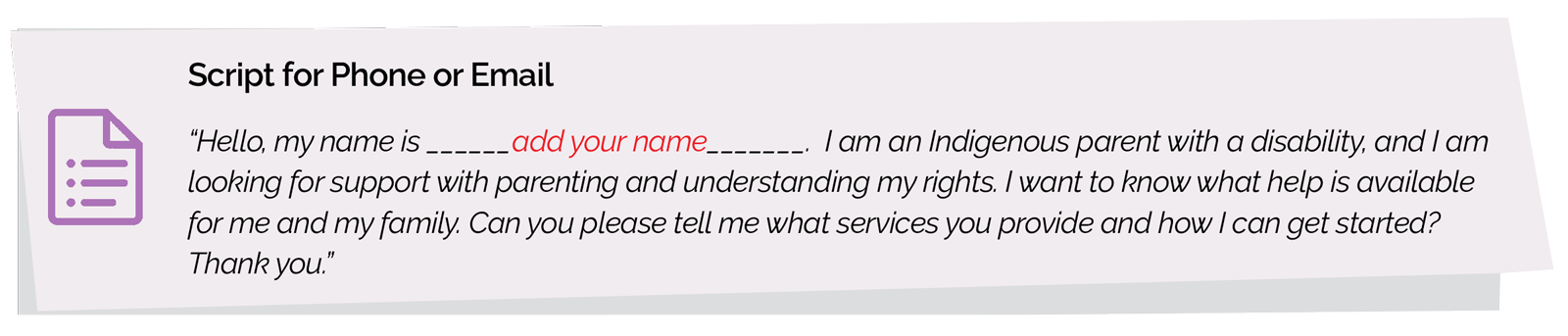
Section 8:
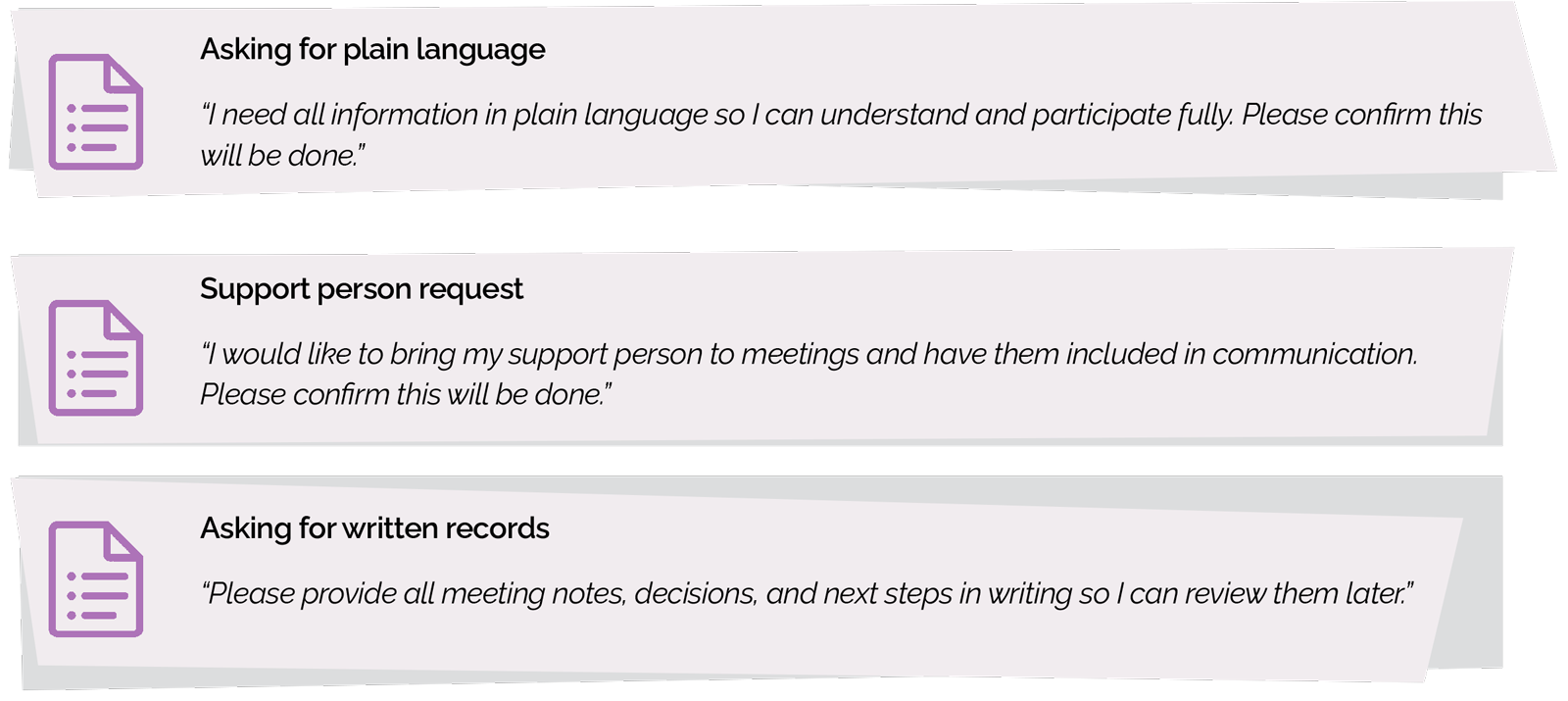
Extra Templates and Scripts
Conclusion
Being a parent with a disability is not a weakness—it is a strength. With the right supports, parents with disabilities show every day that they are loving, capable, and strong.
Hopefully, this toolkit has given you clear information about your rights, what to do if MCFD is involved, how Special Needs Agreements work, and what the end of birth alerts in B.C. means for you. We’ve also shared simple scripts, examples, and contact numbers you can use, along with culturally safe supports for Indigenous parents.
Most importantly, remember you are not alone.
There are people and organizations across B.C. who want to stand with you and your family. Your voice matters, your rights matter, and you and your children have every right to grow and thrive together.

By Family Support Institute of BC