This toolkit provides a detailed
comparison of the two main legal
agreements used by the Ministry of Children and Family Development (MCFD) in British Columbia: the Voluntary Care Agreement (VCA) and the Special Needs Agreement (SNA).
Voluntary Care
Agreement vs Special
Needs Agreements
There are various types of Care Agreements for children used by MCFD. This toolkit outlines Voluntary Care and Special Needs Agreements.
This toolkit outlines their fundamental differences, similarities, and practical considerations to help families understand their options.
Voluntary Care Agreement (VCA)
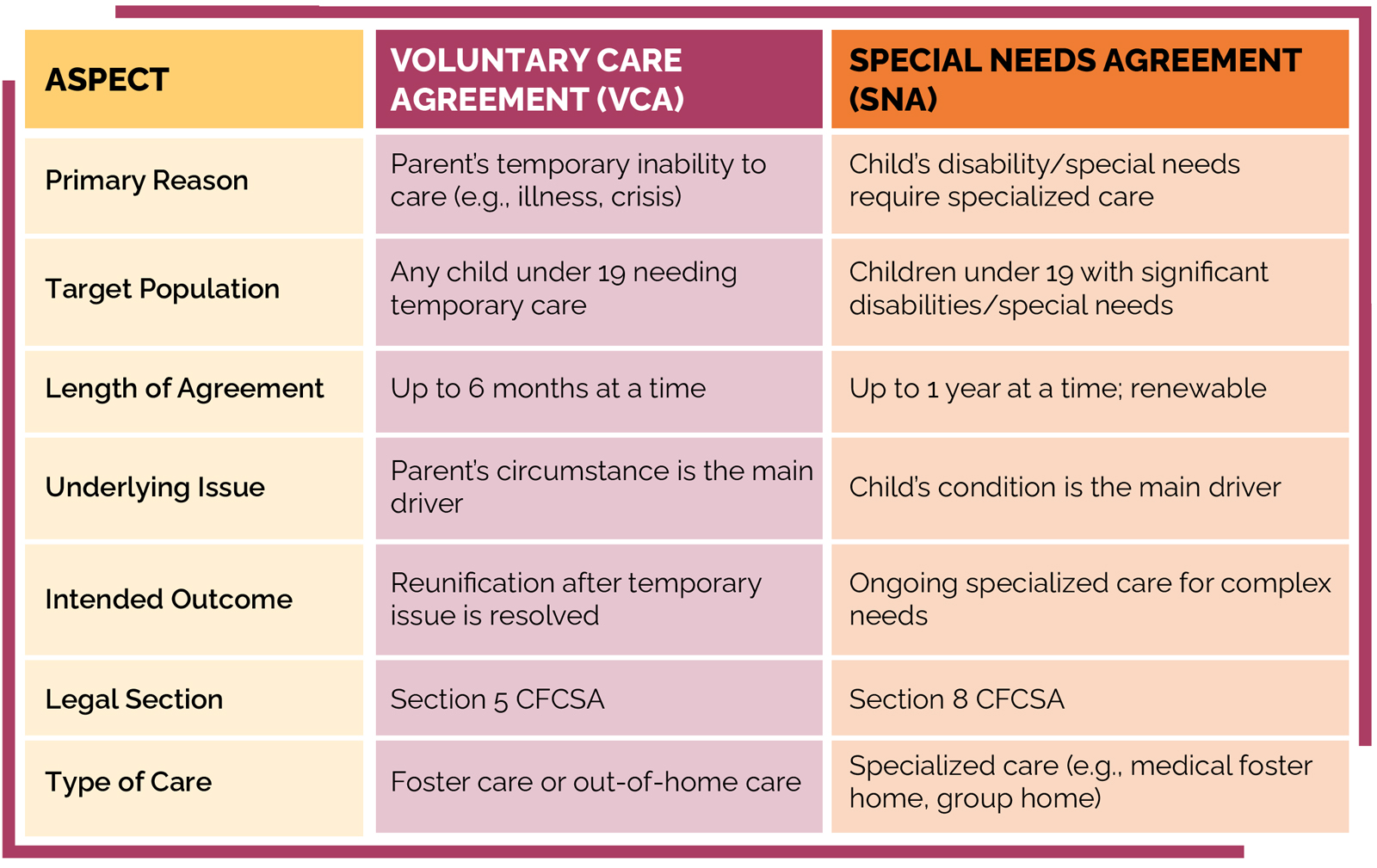
The Voluntary Care Agreement (VCA) is a legal agreement between the parent/guardian and MCFD that places a child in temporary care when the parent is unable to care for the child due to a temporary situation (e.g., illness, crisis).
Parental Rights: Parent retains full guardianship and can end the agreement at any time with written notice (usually 24 hours).
Special Needs Agreement (SNA)
A Special Needs Agreement is a legal agreement between the parent/guardian and MCFD where a child is placed in care because of the child’s special needs (e.g., significant physical, mental, or developmental disabilities).
Parental Rights: Parent retains guardianship; termination of the agreement may require care planning for transition.
Practical Considerations
You may be required to pay support to the ministry if your income is high enough
CCB and tax credits will be suspended during the care agreement
Be mindful of eligibility of supported housing when children are in care
Both VCAs and SNAs are funded by MCFD and include planning meetings.
SNAs typically require a detailed Individualized Service Plan (ISP) due to the complexity of needs.
Key Differences Between VCA and SNA
Rights under either VCA or SNA
They are voluntary agreements: Parents must consent.
Parents retain legal guardianship and decision-making authority.
Family/Child has the right to maintain cultural identity, language, and ties to community.
You are to receive regular updates and visitation.
Parents are involved in care planning and reviews.
Parents can request to terminate the agreement (VCA typically easier to end immediately).
MCFD retains legal responsibility for care and placement while agreements are in effect.